


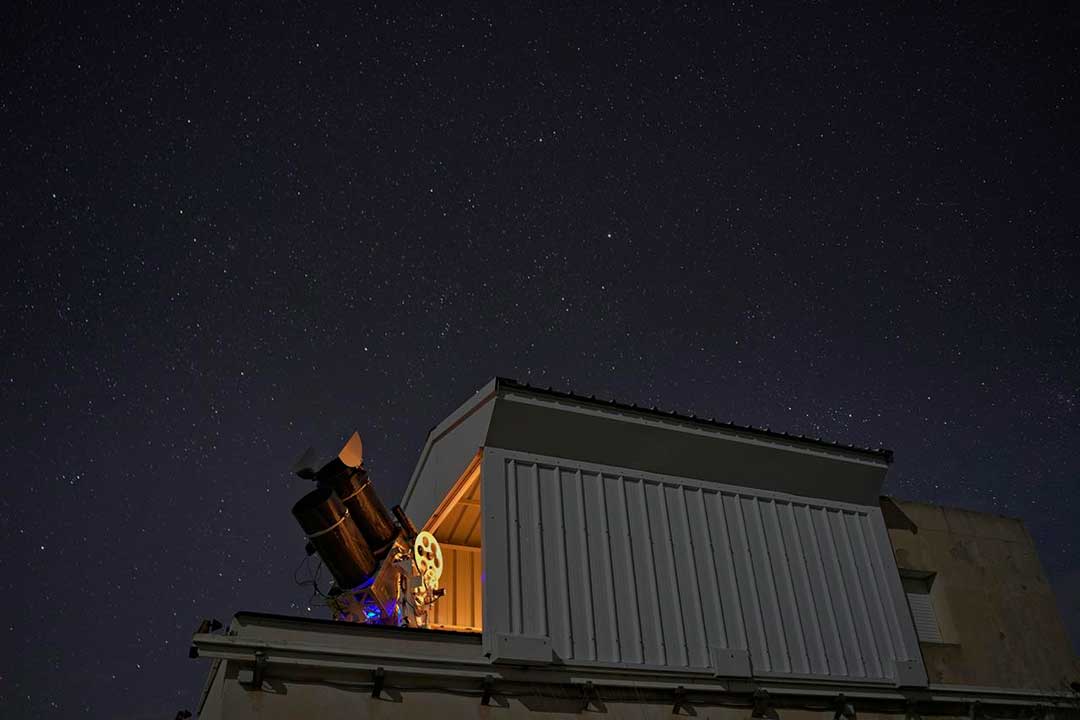
The first Twin Impact Lunar Telescope (TILT) [1], installed at Calern Observatory [2] in July 2025, has recorded [3] its first lunar impact flashes (LIFs) during an observational campaign targeting impacts generated by the Geminid meteor shower on both the Moon and the Earth.
Preliminary data analysis has revealed several candidate LIFs. One event, whose signature is consistent with a double impact (see figure), has been independently confirmed by coordinated observations [4].
TILT is the first of three stations that will be deployed by the Lagrange Laboratory, OCA, and IPGP within the framework of the ERC Listen-Flash project [5]. This network will monitor flashes produced by meteorite impacts on the lunar surface, complementing the Farside Seismic Suite (FSS), Chang’e-7, and Artemis lunar seismometer missions. The scientific objective is to constrain the physical properties of the lunar interior by combining seismological and optical observations of impacts, while also improving our characterization of the meteoroid flux and impact rates on the Moon.
In parallel, in the context of the Artemis IV mission, IPGP and CNES were recently selected by NASA to provide the South Pole Seismic Station (SPSS) instrument [6a]. This seismometer will be deployed on the lunar surface by astronauts. The development of SPSS is led by NASA’s Jet Propulsion Laboratory (JPL) [6b], with major contributions from IPGP [7], CNES, JAXA (Japan Aerospace Exploration Agency), and the University of Tokyo.
Installed near the Moon’s south pole, SPSS will enable detailed investigations of the Moon’s internal structure and seismic activity. It will complement other seismological experiments, notably the Farside Seismic Suite (FSS), which includes another IPGP/CNES seismometer and is scheduled to be delivered to the Moon aboard a robotic mission planned for late 2027.
Together, these coordinated efforts will significantly advance our understanding of the Moon’s internal structure, the frequency and energy of meteoroid impacts, and the dynamics of the circumlunar environment. This contribution strengthens the position of France and Europe in lunar exploration and exemplifies the synergy between ground-based observations, spaceborne instrumentation, and fundamental research in planetary science.
[1] TILT-1 was built by P. Girard (OCA), N. Mauclert (OCA), T. Parra (OCA), M. Delbo (CNRS/Lagrange – OCA), and Bruno Mongellaz (OCA) with funding from OCA-IPGP-Université Paris Cité.
[2] TILT-1 was installed in Calern by B. Mongellaz (OCA), N. Anfosso (OCA), L. Herrier (OCA), D. Grimaldi (OCA), Jean-pierre Rivet (CNRS/Lagrange – OCA) and Enguerrand Maeght.
[3] Observations were conducted on site by a team composed of M. Delbo (CNRS/Lagrange – OCA), D. Sheward (University of Leicester, UK), P-Y. Froissard (IPGP Paris) and C. Sailiby (OCA),
[4] International coordination was provided by C. Avdellidou (University of Leicester) and A. Cook (University of Aberystwyth).
[5] Lead: P. Lognonné (IPGP); Co-Lead M. Delbo (CNRS/Lagrange – OCA), https://cordis.europa.eu/project/id/101199624
[6a] https://cnes.fr/communiques/linstrument-francais-spss-sera-bord-de-mission-americaine-artemis-iv
[6] Lead M. Panning (JPL/NASA)
[7] Co-Lead P. Lognonnné (IPGP).